By Braille Quill editorial team · Last verified [date]
Install the client
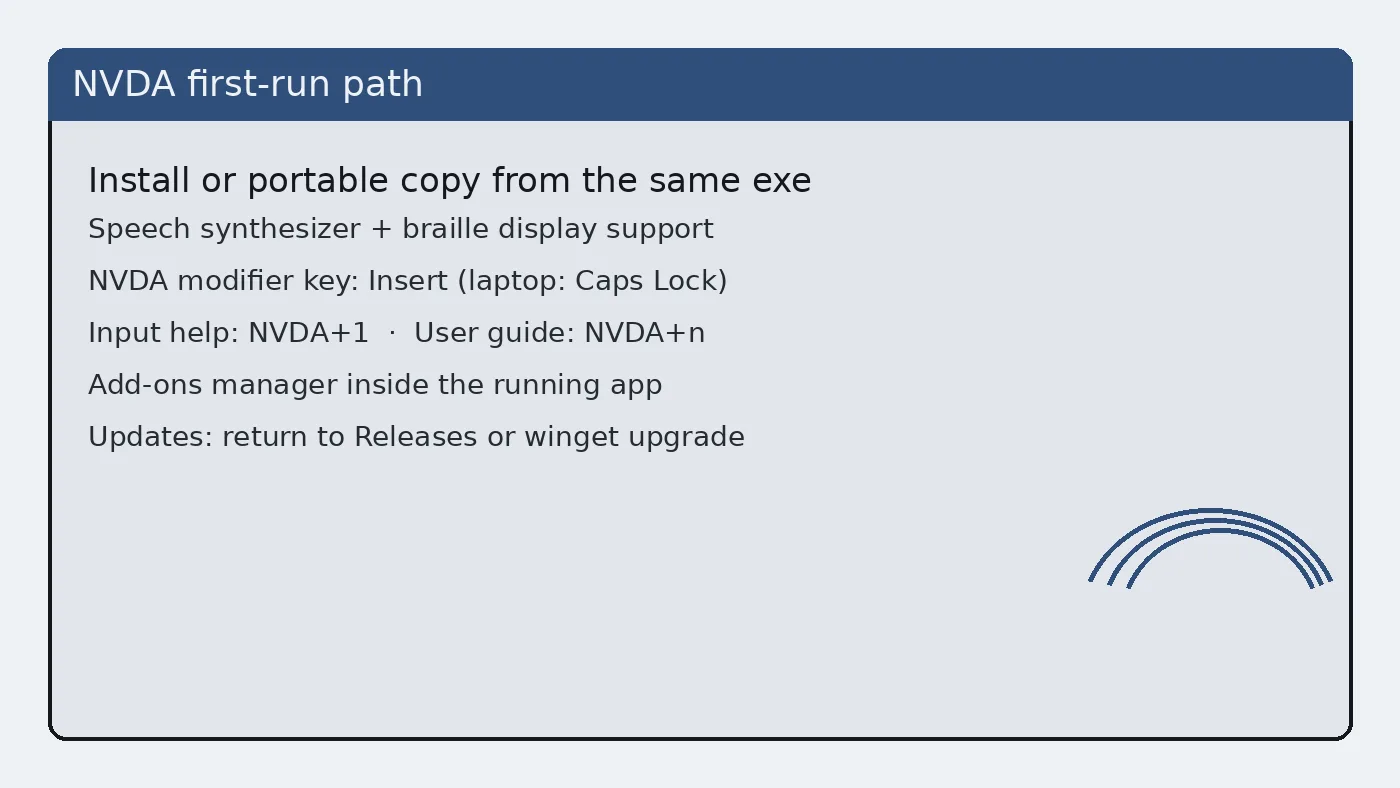
Use winget NVAccess.NVDA or nvda_*.exe. See Windows install.
Stop overlap
Exit Narrator before you judge the client speech quality.
Learn commands
Budget practice time. Read vs Narrator and first run.
Keep a fallback
Narrator remains the zero-install path when third-party installs are blocked.
Desk habits that keep installs boring
Write the update door on a sticky note or machine ticket the same day you install. Include whether you used winget id NVAccess.NVDA or a specific nvda_.exe filename from a release- tag. Future you will not remember which mirror felt convenient during a noisy afternoon.
Shared labs should pick one door and refuse improvisation. When SmartScreen blocks a first run, return to the same official URL instead of searching the web for a “working the client crack setup” style result. Those results are how adware enters otherwise careful classrooms.
Portable copies help on USB workflows, but they still need a written home folder path. An unnamed stick in a drawer is not a backup plan. Label the stick and keep a second hashed copy in a software library your organisation controls.
Speech and listening environment
Headphones help in open offices. Speakers help when a trainer needs to hear what the student hears. Either way, confirm the Windows output device before you blame the client. Many silent installs are simply muted mixers or HDMI audio routed to a disconnected display.
If speech starts after a long delay, check startup configuration and antivirus first-run scanning. A freshly downloaded exe may be scanned on first launch. Wait, then prove a reading task rather than downloading a second copy from a different site.
Braille and hardware notes
Attach supported braille displays according to vendor USB guidance, then select the driver inside the client settings. If braille stays inactive, verify the display works on another machine before reinstalling the client. Hardware faults and software faults need different tickets.
Speech-only desks are valid. Do not force braille configuration on images that will never see a display. Extra driver prompts confuse students who only needed voice output for the session.
Security reminders
Prefer github.com/nvaccess/nvda and nvaccess.org. Prefer winget show NVAccess.NVDA when you want catalog metadata. Skip countdown timers. Skip browser extensions offered as download helpers. See the download-safe and is-it-safe guides when something feels off.
Code signing acknowledgements in the upstream README are useful context, not a substitute for checking the URL you typed. Always match the filename pattern nvda_VERSION.exe for stable Windows builds.
Teaching and support
Trainers should demonstrate the screen reader modifier key slowly. Desktop versus laptop layouts change which physical key acts as the client. Say the key names aloud while you press them. Students who only hear “press the client plus N” without a physical reference will open the wrong menus.
Keep a one-page cheat sheet beside the keyboard during the first week. Link that sheet to the official user guide rather than copying large copyrighted chapters into a random shared drive.
When to revisit these pages
Revisit after every major Windows feature update, after every the client release-* bump you deploy, and after any incident involving a portal-downloaded installer. The commands stay short; the discipline around doors is what protects the fleet.
Classroom handoff
Tell students when Narrator is the exam-only tool and when the client is allowed on homework machines. Mixed rules without a written note create accidental policy violations.
Keep a short demo script that starts the client, exits Narrator, and opens Notepad. Rehearse that script before office hours so support staff hear the same sequence every time.
Quiet checklist before you reinstall
Confirm the output device, volume mixer, and whether Narrator is still speaking. Many silent or doubled-voice reports are environmental. Reinstalling without that checklist wastes time and creates duplicate folders.
Keep the Releases URL bookmarked under a boring name. During an outage people invent mirrors. A known bookmark returns you to the same door without search ads.
Save configuration after speech rate changes, especially on portable copies. Forgotten saves look like broken upgrades the next morning.
Frequently asked questions
Do I uninstall Narrator?
Usually no. Narrator is part of Windows. Exit it during NVDA sessions and leave it available for emergencies or locked images. Prefer official GitHub Releases or the verified winget id, then prove speech on a short document after install finishes.
Will Narrator settings import?
No automatic import into NVDA. Rebuild speech rate and verbosity inside NVDA settings after install. Prefer official GitHub Releases or the verified winget id, then prove speech on a short document after install finishes.
What is the first success test?
Arrow through a simple document with only NVDA speaking. That proves the switch more clearly than opening a complex web app first. Prefer official GitHub Releases or the verified winget id, then prove speech on a short document after install finishes.