- nvda_2026.2.exe 61.5 MB 302 downloads
nvda
Windows screen reader from NV Access
Install nvda on Windows with the official build from GitHub Releases or the verified winget package, then confirm speech before you change voices or add braille.
- Local Windows screen reader without a paid seat
- Official Windows exe from GitHub Releases
- GPL-2.0-or-later client with speech and braille support
By Braille Quill editorial team Current release, published August 31, 2026
Install NVDA 2026.2
Windows
Paste into PowerShell or Windows Terminal:
winget install -e --id NVAccess.NVDAPackage: microsoft/winget-pkgs NVAccess.NVDA (YAML-verified)..
Or download the file directly from the official GitHub release:
Download Windows installerWindows 8.1 or later. Prefer the official Windows exe from GitHub Releases, or winget install -e --id NVAccess.NVDA when App Installer is present.
Every file comes from nvaccess/nvda release-2026.2 on GitHub, the project's own release, unmodified.
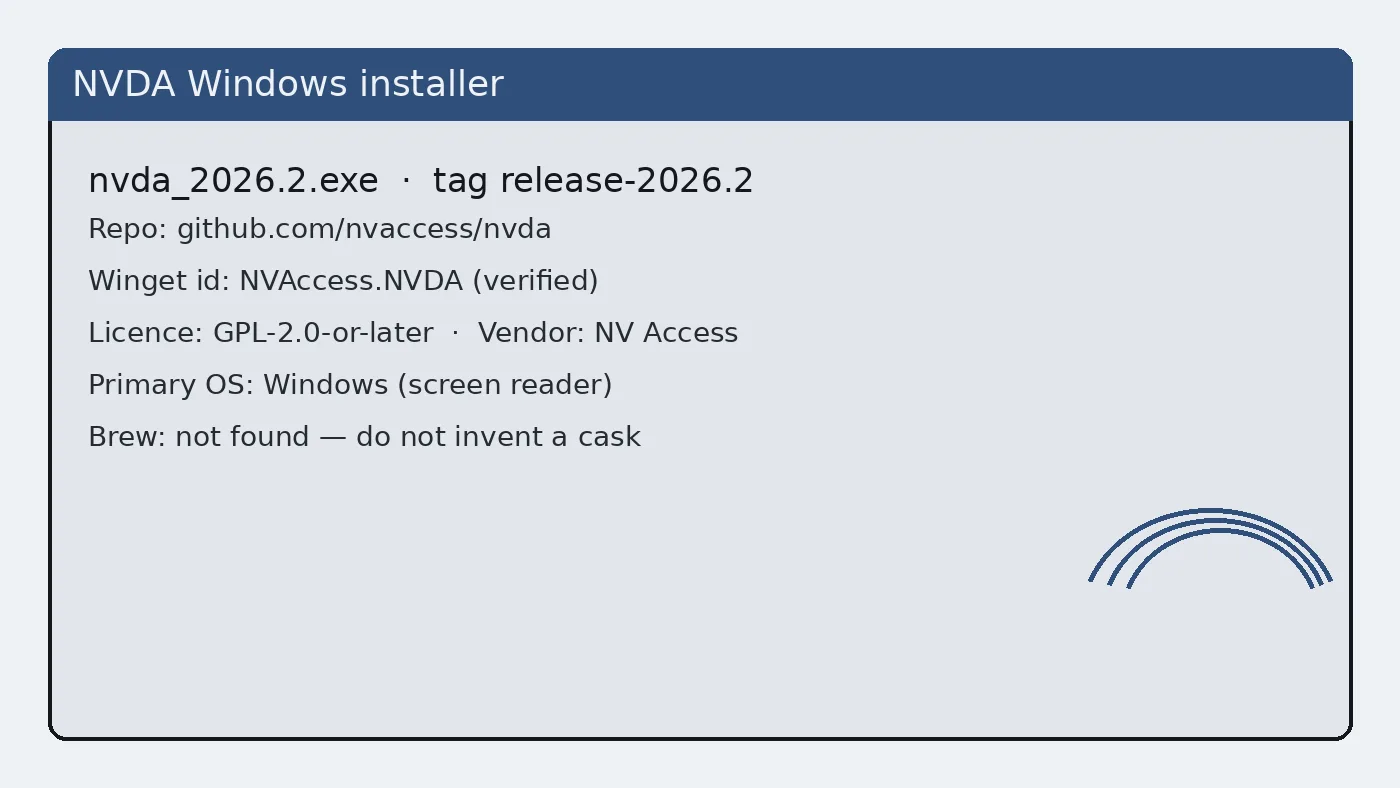
What an nvda job needs
People who type the head term usually want a free Windows screen reader they can install once and keep offline after the first download. The job is speech and braille access on a PC you control, not a browser demo and not a commercial licence seat.
NonVisual Desktop Access from NV Access is the open-source product behind that search. Braille Quill maps the Windows doors: nvda_*.exe on GitHub Releases tags prefixed release-, and winget id NVAccess.NVDA when App Installer is present.
Homebrew has no matching cask on this review date. Do not invent one. macOS VoiceOver is a different product on Apple hardware. these pages stays on the Windows install path for the screen reader.
Related: releases, GitHub, download safely, Windows install.
LicenceGPL-2.0-or-later on GitHub
Primary file
nvda_*.exe on release tagsWinget
NVAccess.NVDA verifiedWhy this desktop path
A dedicated screen reader stays on the machine after install. You control the update door. Speech and braille settings live in the client configuration instead of a temporary browser tab.
Winget keeps fleet images honest when the catalog is allowed. The exe keeps labs honest when package managers are blocked. Both doors publish the same NV Access product for everyday Windows desks.
Commercial screen readers still win when an organisation already standardised on JAWS training. Narrator still wins when you cannot install anything. Choose the open-source client when you want GPL source, a named Releases asset, and a desk path that does not start with a paid quote.
Install by operating system
Windows is the supported desktop for NonVisual Desktop Access. Brew was searched and not found. Treat non-Windows platforms as out of scope here.
| OS | Door | Notes | Guide |
|---|---|---|---|
| Windows | winget install -e --id NVAccess.NVDA | microsoft/winget-pkgs · NVAccess.NVDA | Windows install |
| Windows manual | nvda_*.exe | GitHub Releases release-* or nvaccess.org/download | releases |
| macOS | Not applicable | No brew cask found; VoiceOver is separate | macOS notes |
| Linux | Not applicable | Product targets Windows | Linux notes |
Longer OS path: Windows. Machine chooser: for this computer. File map: releases. Winget howto: how to install winget.
Eight steps to first speech
- Open the official release door Open GitHub Releases for the upstream repository or the vendor download page and confirm you see the Windows exe, not a renamed portal setup.
- Prefer the Windows exe from the current release tag Take the installer that matches the live tag. Keep one filename written on the machine ticket.
- Or run the verified winget id When App Installer is present, run the exact winget install command for NVAccess.NVDA. That id is YAML-verified in microsoft/winget-pkgs.
- Finish install or portable copy Approve UAC when prompted. Choose a full install or a portable copy so the program folder stays where you expect after the first launch.
- Confirm speech starts Launch the client and confirm speech output before you change voices. If Windows Narrator is also speaking, stop Narrator for the session.
- Set the modifier key Use Insert on a desktop layout or Caps Lock on a laptop layout. Open the menu with the modifier plus N and check Preferences → Settings.
- Prove one short reading task Arrow through a Notepad window or browser page so speech tracks focus. That proves the install before you add braille or add-ons.
- Keep one update door Return to the same GitHub Releases filename or winget upgrade. Skip adware wrappers that only rank for screen-reader searches.
First hour checklist: installed. First-run habits: first run.
First hour after install
Success is a session that speaks focus on a machine you control, not three download folders full of renamed setups. Launch the client, prove one short reading task, then adjust speech rate before you chase add-ons.
SmartScreen prompts are common on first launch of newly downloaded exes. Prefer the Releases URL or winget id you typed yourself. Safety overview: is it safe. Speech tips: speech settings.
How to choose a screen reader client
A careful buyer asks where speech lives, whether source is public, which platforms the window supports, and whether the download door is a named GitHub asset or verified winget id. Built-in Narrator answers with zero install. Commercial JAWS answers with training contracts. NonVisual Desktop Access answers with GPL builds and a Releases filename.
Pick the open-source client when you want a free Windows screen reader with speech and braille. Pick Narrator when install rights are missing. Pick JAWS when your workplace already standardised on that training path.
- Can you install from a filename or winget id you can write on a ticket?
- Does the licence let you read the client source?
- Can you use speech offline after the first download?
- Do settings stay under your control on that desk?
NonVisual Desktop Access compared with other options
The table below is a desk comparison, not a ranking of training vendors. Narrator wins at zero install. JAWS wins at commercial support contracts. This open-source client wins at a local GPL build with public source for a Windows path.
| Product | Price | Open source | Offline after install | Signup required | Verdict |
|---|---|---|---|---|---|
| NVDA | Free (GPL-2.0-or-later) | Yes | Yes | No | Local Windows path these pages maps |
| Narrator | Included with Windows | No | Yes | No | Zero install; lighter than dedicated SR |
| JAWS | Commercial licence | No | Yes | Vendor account typical | Paid support path; not this exe door |
| Download-portal wrappers | Free + adware risk | Usually no | Varies | Often | Skip; use GitHub or nvaccess.org |
| VoiceOver | Included with Apple OS | No | Yes | No | Not a Windows install |
Narrator still wins when you cannot install software. JAWS still wins for shops with existing training. Portal wrappers never win. The GPL client is the install path when you want exact Releases names and a desk tool that does not start with a paid quote. Longer comparison: vs Narrator.
Free client vs paid seats
NonVisual Desktop Access itself is free under GPL-2.0-or-later. GitHub Releases assets named above have no paywall for the screen reader. NV Access may offer optional training materials or donations on nvaccess.org; those purchases are not required for basic speech.
Commercial screen readers sell licences and support. Those purchases do not replace a local install, and these pages does not sell those seats. If you already have a Narrator habit, keep it until a dedicated session sticks.
Mistakes that undo an install
Downloading a second Softonic-style copy to fix a blocked first run. Leaving Narrator and the client speaking together. Inventing a brew cask that was not found. Mixing random setup files without notes.
- Take
nvda_*.exefrom GitHub Releases or nvaccess.org, not a renamed portal. - Prove one local speech session before chasing add-ons.
- Write the update door on the machine ticket.
- Stop Narrator when both voices talk over each other.
- Do not invent a brew id that was not found.
Fix each mistake the same way: one honest door, one proven speech session, one documented path. Switch habits: move off JAWS.
Guides index
Install guides cover Windows and platform notes. Setup guides cover first run, speech, braille, safety, and update or uninstall. Comparison and switch pages help when Narrator or JAWS is already open. Browse all: guides.
Install by operating system
Comparisons
Switch and import
Setup and accessibility
Repeatable desk habits
Write the update door on the machine ticket beside the OS version. nvda_*.exe and winget NVAccess.NVDA are different doors to the same product. Mixing portal wrappers beside them creates confused uninstalls after a reimage.
Family PCs, school labs, and workplace images all benefit from the same boring rhythm: one installer door, one configuration habit, one documented update path for the screen reader.
Everyday limits
The client does not replace braille display hardware you do not own. It does not make a missing sound device into speech. It does not remove the need to trust the exe you downloaded. Offline use still needs network for the first fetch.
Settings that matter early
Speech rate, voice, punctuation level, and keyboard layout matter more than decorative chrome. Prove a local reading task before you install many add-ons. Speech guide: speech settings. Braille guide: braille.
After the first speech session
Only after one reading task works should you explore braille displays or the add-ons manager. Keep Releases bookmarked. Prefer the tag that still ships your Windows exe. Update guide: update uninstall.
Keeping the job name clear
Here the head term means a local screen reader you install and operate on Windows. A review portal that only ranks for the search is still the wrong binary. Prefer nvda_*.exe or winget NVAccess.NVDA, then prove speech before you batch other downloads.
When someone pastes a random “best download” link into chat, ask for the GitHub Releases URL or nvaccess.org/download instead. The install path on these pages always returns to nvaccess/nvda for the product.
Remember the job: a local GPL-2.0-or-later screen reader plus a file or winget id you control. A download-portal mirror that only ranks for the head term is still the wrong binary. Prefer the named Releases assets, then prove one speech session before you add alternate doors.
Narrator still wins when you only need a built-in voice for a minute. Commercial seats still win when training contracts already exist. Choose NonVisual Desktop Access when you want GPL builds, exact Releases names, and a desk path that does not start with a signup.
Braille Quill publishes the install guide. Upstream remains at nvaccess/nvda under GPL-2.0-or-later. When Releases change which assets appear, re-check the live list before you image a lab.
Lab and travel notes
Travel laptops benefit from a single documented installer door written beside the folder that holds the configuration. Lab images drift when someone installs a second mirror during a blocked SmartScreen prompt. Prefer returning to the same Releases URL or winget id instead of inventing a new download mid-flight for a speech session.
School machines should receive the installer on hardware they control, plus a shared note for the update door. Shared desks should keep Narrator available as a fallback until the dedicated habit sticks for the whole room.
Classroom images should pin the exact filename beside the OS version. After every reimage, prove one short local speech session before you call the machine ready. That habit catches vanished portable folders and adware shortcuts that reappear from old bookmark exports.
Users who already live in Narrator can keep that path. Treat the Windows exe as the dedicated path for teammates who need a named Releases asset. The two can share habits when the room documents which path is official for demos of this screen reader.
Support rhythms for shared rooms
Helpdesks move faster when every ticket names the installer door and the Windows build together. Vague reports that only say the screen reader feels wrong waste a day. Ask for the filename or winget id, the approximate install date, and whether Narrator was also running during the complaint.
Trainers should keep a spare pair of headphones in the room. Open offices make speech demos hard to judge. A quiet corner and a short Notepad file beat a noisy demo on a complex website when you are proving a fresh install.
Inventory braille displays separately from software. A broken cable looks like a driver failure. Tag hardware with the matching settings note so substitutes do not guess under pressure.
When imaging season arrives, freeze the golden machine only after a reboot test. Logon scripts and antivirus first-scan delays hide problems that a same-session demo misses. The boring reboot test saves weekend emergency calls.
Writing internal runbooks
Internal runbooks should quote the winget id and the Releases URL without adding marketing adjectives. Staff skim under stress. A short checklist with five boxes outperforms a three-page essay that nobody finishes.
Include a rollback line: where the previous exe lives, how to uninstall, and who owns the software library hash list. Rollback plans fail when the only copy sat on a retired laptop.
Translate jargon for volunteers. Say “Stop the built-in Windows voice first” instead of assuming everyone knows Narrator’s exit command. Clarity beats cleverness during the first week of a new semester.
How do I install nvda on Windows?
Prefer nvda_*.exe from the current release-* tag on nvaccess/nvda GitHub Releases, or run winget install -e --id NVAccess.NVDA when App Installer is present. Both doors map to the same GPL-2.0-or-later build for a local Windows screen reader. Avoid renamed setups from advertising download portals that only rank for the head term.
Where should I download nvda?
Use GitHub Releases for nvaccess/nvda, nvaccess.org/download, or the verified winget package NVAccess.NVDA. Those doors publish named Windows assets such as the official exe on release tags. Softonic-style portals often wrap the same search intent with extra installers you did not ask for.
Is nvda free?
NonVisual Desktop Access is free under the GPL-2.0-or-later license published on GitHub. You can use the Windows screen reader without buying a seat from these pages. Optional training materials or donations on nvaccess.org are separate and are not required for a basic speech session.
Can I switch into nvda from JAWS or Narrator?
Yes. Install from GitHub Releases or winget NVAccess.NVDA, then prove speech on a simple document. Stop Narrator if both voices speak. JAWS settings do not transfer automatically, so remap keystrokes from the user guide as you learn the new modifier key.
Does the desktop nvda work offline?
Yes. After install, the client speaks on your machine and does not need a cloud account for basic screen reading. You can work offline once speech is running. Updates still come from GitHub Releases or winget when you choose to fetch them later.
Official releases
All releases on GitHub- GitHub stars
- 2,636
- Downloads, last 3 releases
- 1.6k
- Latest version
- 2026.2
2026.1.1
release-2026.1.1
- nvda_2026.1.1.exe 60.0 MB 1k downloads
2026.1
release-2026.1
- nvda_2026.1.exe 60.0 MB 295 downloads
Counts come from the GitHub API at build time and only cover the release-* tags shown here. Package managers (winget, Homebrew, Snap, Flathub) and app stores are not included.